Labels

Evolution (14) DNA (6) Bible prophecies (5) Blood Moon (4) prophecies (4) Blind faith (3) Book of Daniel (3) Eve (3) God (3) God's fingerprints (3) Intelligent Design (3) Moses (3) Only way (3) Star of Bethlehem (3) Trinity (3) mtDNA (3) origin of life (3) Adam & Eve (2) Allah (2) Analogy of Trinity (2) Ashley Madison (2) Bible reliability (2) Common Ancestor (2) Exodus (2) Hawking (2) Herod (2) Islam (2) Jericho dispute (2) Jesus (2) Muslims. (2) Nicky Cruz (2) Pharaohs (2) Plagues (2) RNA (2) Torah (2) atheism (2) fun story (2) genocide (2) iron teeth monster (2) leap of faith (2) magi (2) rationality (2) science & faith (2) science updates (2) serpent (2) skeptics (2) sufferings (2) truth (2) virgin birth (2) AI (1) Abraham's test. 自導自演 (1) Acts (1) Adam (1) Akhenaten (1) Andrew Chan (1) Ape DNA (1) Armageddon Book of Joel (1) Astrology (1) Astronomy (1) Atheists (1) Ave Maria (1) Balaam (1) Baphomet (1) Beheadings (1) Bethlehem babies (1) Bethlehem star (1) Bible (1) Bible & Phi (1) Bible & Science (1) Bible scurtiny (1) Big Bang (1) Book of Luke (1) Bryant Wood (1) Buddhism (1) Canaan Conquest. (1) Carbon 14 tests (1) Constantine (1) Council of Nicaea (1) Da Vinci Code (1) Dan Brown (1) David Wood (1) Dead Sea Scrolls (1) Doom sayings (1) Evolution,Darwinism (1) Fibonacci number (1) Forgiveness (1) Garden of Eden (1) Genome comparison (1) Goat statue (1) God delusion (1) God is cruel? (1) God's glory (1) God's grace (1) God/man dual nature (1) Golden Angels Choir (1) Golden ratio (1) Gravity Wave (1) He will carry you. 4 You tube songs (1) Holocaust (1) Hominid Hype (1) Homo Naledi (1) ISIS (1) Information (1) Isaiah 53 (1) Jericho (1) Jericho walls (1) Jesus & Gospels (1) Jesus' Deity (1) Jesus' tomb (1) Jesus' youth (1) John the Baptist (1) Joseph's scheme (1) Karma (1) Killing God (1) Mary promotions (1) Michael Brown (1) Musical chords (1) Nabeel Qureshi (1) Nikolas Cruz (1) OT Bible (1) Octopus (1) Paul's conversion (1) Phi (1) Prophecies.. (1) Prophecies.Bk of Daniel (1) Quran (1) Richard Dawkins (1) Roman Empire (1) Satan (1) Sh'khinah (1) Son of God (1) Suicide (1) Ted Bunny (1) The Cross & guillotines (1) Tree of Knowledge (1) Trinity analogy (1) Wisemen (1) Y DNA (1) absurdity of life (1) acoustic resonance (1) animal migrations (1) apologetics (1) atheist Pro (1) chicken or eggs (1) comet (1) comparisons of religions (1) creation (1) dialogue with M (1) doubting Thomas, (1) earthquake (1) emperor's cloth (1) empty tomb (1) evil (1) executions (1) fabrication (1) falling down (1) fine tuning of universe (1) free will (1) goodness (1) hallucination (1) hell (1) history (1) human hibernation. suspended animation (1) justice (1) life is short (1) logic (1) meaning of life (1) movie (1) multiverse (1) nature's laws (1) objections fr Jews (1) original sin. Bible out of context (1) original sin. temptations (1) pains (1) philosophy. (1) philosophy. Big Bang (1) popes (1) porn addiction (1) probabilities (1) reality check (1) reincarnation (1) relationship (1) restoration (1) resurrection (1) sanke handler (1) science & God (1) self disclosure (1) short skit (1) sin (1) sins (1) snake (1) songs (1) stumbling blocks (1) the Star of Bethlehm (1) theology (1) unusual birth (1) who made God (1) why. love letters (1) wise men (1) 人類的起源, 進化論 (1)

Monday, December 14, 2015

How Could They Forgive the Killer of Their Loved Ones?


Dylann Roof, the Black Church and 'The Love That Forgives'


Read more at http://www.christianpost.com/news/dylann-roof-black-church-race-faith-angle-forum-ame-african-american-bible-martin-luther-king-love-forgive-152213/#W7agqJcCDXzluryq.99

Read more at http://www.christianpost.com/news/dylann-roof-black-church-race-faith-angle-forum-ame-african-american-bible-martin-luther-king-love-forgive-152213/#oGVAgMEeAG3msOdj.99


MIAMI BEACH — How could members of a black church forgive the man who murdered nine of their brethren? Historian Albert J. Raboteau explained the rich tradition of forgiveness within the African-American church experience at last month's Faith Angle Forum.
On June 17, Dylann Roof shot and killed the pastor and eight other members of Emanuel African Methodist Episcopal Church in Charleston. After the tragedy, the nation watched with wonder as family members of those slain spoke to Roof at a bond hearing, calling him to repentance and forgiving him.
"I forgive you," the emotional daughter of Ethel Lance, 70, one of the victims, told Roof. "You took something really precious from me. I will never talk to her ever again. I will never be able to hold her ever again, but I forgive you!"
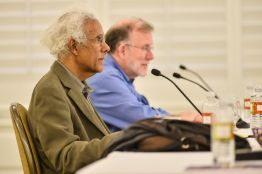
Albert J. Raboteau, Michael Cromartie(Photo: Rodrigo Valera Photography)
Albert J. Raboteau, (Henry W. Putnam Professor Emeritus of Religion at Princeton University), (foreground) and Michael Cromartie, vice president of Ethics and Public Policy Center, at Faith Angle Forum, Miami Beach, Florida, Nov. 16, 2015.
Raboteau looked at this history of forgiveness in the black church through the lives of six figures: Fannie Lou Hamer, Annelle Ponder, Martin Luther King Jr., Francis Grimke, Mary Younger, Solomon Bayley and William Grimes; and concluded with a personal story about the murder of his father by a white man in Mississippi.
Due to slavery, Raboteau explained, two different versions of Christianity developed in the United States: that of the slave owners and that of the slaves. Black Christians developed "an alternative religious narrative" to that of white slave-owning Christians and their supporters that contradicted "the dominant national myth of America as God's New Israel or alternately as the Redeemer Nation."
Where the dominant national myth saw the United States as the "new Israel," slave Christians saw a better metaphor in Egypt during the time of Jewish captivity.
"While generations of white American preachers and politicians spoke of America ... as a New Israel, the Promised Land. African-Americans maintained that on the contrary this nation was the Old Egypt, 'Go Down Moses and Tell Old Pharaoh to Let My People Go' and would remain so until all of God's children were free," Raboteau said.
These were not minor theological differences, Raboteau continued, but went to the core meaning of the Gospel.
These African-American Christians "developed a radical criticism of the cultic piety of American exceptionalism," he said. "In their narrative Christianity and slavery were incompatible."
America had two gospels.
"This conflict between two versions of Christianity, one that accommodated slavery and the other which did not affected more than legal status. It bifurcated the meaning of the Christian Gospel," he said.

William Grimes was a former slave. In forgiving his master, he identified with his Savior.

Recalling a time that his master accused him of a crime he did not commit, Grimes said in 1855, according to Raboteau, "When I considered him accusing me of stealing, when I was so innocent, and had endeavored to make him satisfied by every means in my power, that I was so, but he still persisted in disbelieving me, I then said to myself, if this thing is done in a green tree what must be done in a dry? I forgave my master in my own heart for all this, and prayed to God to forgive him and turn his heart."
Grimes was referencing Luke 23:31, "For if they do these things in a green tree, what shall be done in the dry?" and identifying with the suffering Savior.
"This allusion reveals that it was from his morally superior vantage point that Grimes was able to forgive his master, who lived under threat as he saw it of devastating punishment," Raboteau explained.
"Simply put, Grimes' view of himself, what it meant for him to forgive his master creates a moral leverage or an act of moral jujitsu if you will, which elevates him over his master.
"In short, if Jesus came as the suffering servant, who resembled him more, the master or the slave?"
Similarly, Solomon Bayley struggled to forgive the man who sought to sell his wife and daughter even as they attended the same Methodist meeting.
"This was a cause of wrestling in my mind but that scripture abode with me, 'He that loveth father or mother, wife or children, more than me, is not worthy of me' then I saw it became me to hate the sin with all my heart, but still the sinner love; but I should have fainted, if I had not looked to Jesus, the author of my faith," Bayley said.
Raboteau believes Bayley's ability to imitate Christ in that circumstance is tied to the intense suffering he was forced to endure.

"The attitude which Bayley struggled to achieve in imitation of Jesus seems incredible unless one perceives it as a way of holding onto meaning in the midst of the absurdity of unchecked white supremacy at its worst," he said.

Saturday, December 12, 2015

Can a Virgin Give Birth?

Dear friends:

If science or nature could achieve so much, couldn't our Creator God do a much wonderful unique one time miracle to bring out Jesus' virgin birth? "
(Click the link below for the original post)

http://www.slate.com/articles/news_and_politics/explainer/2007/12/can_a_virgin_give_birth.html


Also click the following link for further thinking


Can a Virgin Give Birth?
Yes—but it's very, very, very, very unlikely.


During the holidays, Christians celebrate the birth of baby Jesus to his virginal mother. We know that female wasps, fish, birds, and lizards can produce healthy offspring without having sex, but what about people? Are natural human virgin births possible?
Yes, in theory. However, a number of rare events would have to occur in close succession, and the chances of these all happening in real life are virtually zero. For a virgin to get pregnant, one of her eggs would have to produce, on its own, the biochemical changes indicative of fertilization, and then divide abnormally to compensate for the lack of sperm DNA. That's the easy part: These two events occur in the eggs or egg precursor cells of one out of every few thousand women. But the egg would also need to be carrying at least two specific genetic deletions to produce a viable offspring.
An egg will only start dividing once it senses a spike in cellular calcium. This normally occurs as a result of a sperm's entry during fertilization. But if the egg happens to experience a spontaneous calcium spike, it will start reacting as if it's been fertilized. A defective sperm that lacks DNA can produce a spurious calcium spike. In the lab, scientists can coax unfertilized eggs into beginning the post-fertilization process by simply injecting them with calcium.
Once fertilization—or faux fertilization—occurs, an egg can complete the final stage of a cell division known as meiosis II, during which it loses half of its genetic material to make room for the sperm's DNA. But if there's no sperm, each half of the divided egg cell will end up short, and both will die. In order for our virgin birth to proceed, the faux-fertilized egg must, therefore, not complete meiosis.
Both of these events—the calcium spike and the division mistake—could occur as the result of random dysfunctions or genetic defects. Assuming they do, the egg cell may then begin the process of "parthenogenesis," or virginal development. When this happens to an egg-precursor cell, it can give rise to a tumor made up of many different types of tissue—liver, teeth, eye, and hair, for example.
Parthenogenesis in humans never produces viable embryos, though, because unfertilized eggs lack specific instructions about gene expression from the sperm. In general, our cells have two functional copies of each gene—one inherited from the mother and one from the father. For some genes, however, only one copy is ever used, while the other remains dormant. Some of the signals for which copies should be turned off come from the sperm cell. So, if there's no sperm, certain genes will be overexpressed, and the "embryo" will die when it is only about five days old.
There's a way around this problem, too. By eliminating a pair of maternal genes, a Japanese team was able to create, via parthenogenesis, a viable baby mouse that was seemingly unaffected by its lack of paternal imprinting. Although the scientists engineered these changes in the lab, there's at least a theoretical possibility that this could happen spontaneously via random gene deletions.
So, while it's possible for a human baby to be born of a virgin mother, it's very, very unlikely: These two genetic deletions might each have a one in 1 billion chance of occurring, and that's not counting the calcium spike and division problem required to initiate parthenogenesis in the first place.
Bonus Explainer: Are there any case reports of virgin births in the medical literature? Sort of. According to a 1995 report in the journal Nature Genetics, a mother brought her infant boy to the doctor after noticing that his head was developing abnormally. When doctors analyzed his blood, they found something truly bizarre: Despite his anatomically male features, the boy's blood cells were entirely female, consisting only of genetic material from his mother. Some of his other cells—such as those found in his urine—were normal, consisting of a combination of both maternal and paternal DNA. No one knows exactly how this occurred, but the best guess is that immediately after being fertilized, one of his mother's eggs fused with a neighboring unfertilized egg that was dividing parthogenetically. This gave rise to a boy who was considered half-parthenogenetic, since approximately half of his cells were derived from a "faux" conception, containing no remnants of his father's DNA.
Explainer thanks Jose Cibelli of Michigan State University, George Daley and Willy Lensch of Children's Hospital Boston, Shoukhrat Mitalipov of the Oregon Stem Cell Center, and Kent Vrana of Pennsylvania State University.

Is Virgin Birth Scientifically Possible?

http://www.christiananswers.net/q-aiia/virginbirth.html

Isn't the virgin birth of Jesus Christ scientifically impossible?

Larry King, the CNN talk show host, was once asked who he would most want to interview if he could choose anyone from all of history. He said, “Jesus Christ.” The questioner said, "And what would you like to ask Him?" King replied, "I would like to ask Him if He was indeed virgin-born. The answer to that question would define history for me."
   —from Just Thinking, RZIM, Winter 1998

Critic's Claim #1
The idea of a virgin birth is SCIENTIFICALLY IMPOSSIBLE.

Pregnant woman. Illustration copyrighted.Really? Where have you been for the past 21 years? Ever since in vitro fertilization and embryonic transfer came on the scene in 1978 (not to mention artificial insemination), it is quite possible for a woman who has never experienced sexual intercourse to give birth.
Of course, the Bible makes it clear that it was Almighty God, not some high-paid gynecologist, who worked the details of Jesus' Divine-Human conception, i.e. And the angel answered and said unto [Mary], The Holy Ghost shall come upon thee, and the power of the Highest shall overshadow thee: therefore also that holy thing which shall be born of thee shall be called the Son of God.”
   —Luke 1:35, KJV.
The angel replied to her:
“The Holy Spirit will come upon you,
and the power of the Most High will overshadow you.
Therefore, the holy One to be born
will be called the Son of God.
Sound miraculous? Of course. But these days, who would deny that miracles occur? And such a 'small' one for the God who created the entire universe!

Critic's Claim #2
The idea of a virgin birth is MYTHOLOGICALLY DERIVED.

Author Patrick Campbell (The Mythical Jesus) and Episcopal Bishop J.S. Spong are two of a number of individuals who have suggested that "…the virgin birth account [is a]…clearly recognized mythological element in our faith tradition whose purpose was not to describe a literal event but to capture the transcendent dimensions of God in the earthbound words and concepts of first-century human beings."
Both men, however, overlook a simple fact: No respectable Jew would have ever condescended to buy into a Greek/Babylonian mythological base for an account dealing with the birth of his/her Messiah.

Critic's Claim #3
The idea of a virgin birth is HISTORICALLY UNSUPPORTED

Feather pen. Illustration copyrighted.The Apostles' Creed, written in the 4th century; the Nicene Creed, adopted at the Council of Nicea in 325 A.D.; the Athanasian Creed, written about 450 A.D.; the Chalcedon Definition, adopted at the Council of Chalcedon in 451 A.D.; and the Small Catechism of Martin Luther of 1529 A.D. are only a few of the historic creeds that recognize the veracity of the Virgin Birth of Jesus. Only in more modern times have Bible critics begun to try to cast doubt on a doctrinal truth that the Church has long since historically endorsed.

Critic's Claim #4
The idea of a virgin birth is BIBLICALLY UNCONVINCING

Some critics cite the fact that the Apostle Paul is silent on the subject of the Virgin Birth, and the fact that Mary's virginity is never mentioned in the Gospel According to John, as evidence that Jesus was never born of a virgin.
But the argument from silence, always a rather weak tactic in making a case, is particularly weak here due to the fact that both Paul and John were alive and quite familiar with the Gospel accounts written by Matthew and Dr. Luke (a physician!)—and yet never either questioned or refuted it.

Critic's Claim #5
The idea of a virgin birth is STATISTICALLY UNWARRANTED

If you really want to put truth up for a vote (and who does?), let's get all of the statistics out in the open. While it is true that one very famous poll taken in 1965 (and still being frequently cited today) of 7,441 Protestant clergy showed that many mainline denominational ministers were not convinced of the truthfulness of the Virgin Birth, a more recent Harris poll of a randomly selected group of 1,011 adults found that 91% of U.S. Christians do believe in the Virgin Birth. All of which goes to show that when it comes to determining spiritual truth, our authority ought to be the Bible (Isaiah 7:14, Matthew 1:25), not men—including clergy!
( also click the link below for further thinking)

Friday, December 11, 2015

Archaeologists Discover Evidence of King Hezekiah


Archaeologists Discover Evidence of Hezekiah


Eric Metaxas
An amazing find in Israel has set the archaeological world on its ear. And once again we see the veracity of biblical history.


Five years ago, a team of archaeologists digging "at the foot of the southern part of the wall that surrounds Jerusalem's Old City" came across a refuse dump dating to the eighth century before Christ.
As the New York Times told its readers, it's "an area rich in relics from the period of the first of two ancient Jewish temples." Among their findings were thirty-three clay imprints or seals, known as bullae. These seals were catalogued and stored.
It wasn't until recently that these bullae were examined more closely, and what the closer examination revealed is rocking the archaeological world. One of the bullae bore the inscription "Belonging to Hezekiah (son of) Ahaz king of Judah."
That would be the Hezekiah of which the Bible says, "He trusted in the Lord, the God of Israel, so that there was none like him among all the kings of Judah after him, nor among those who were before him. For he held fast to the Lord. He did not depart from following him, but kept the commandments that the Lord commanded Moses" (2 Kings 18:5-6)....As Eliat Mazar of Hebrew University told the Times, "It's always a question, what are the real facts behind the biblical stories . . . Here we have a chance to get as close as possible to the person himself, to the king himself."
You'll pardon me for saying, but how cool is that?!
Now, if you're a regular BreakPoint listener, you know that this is only the most recent in a series of archaeological finds that are confirming the historical nature and veracity of the biblical narratives. A few years ago, I told you about the discovery of Shaarayim, one of the two cities of David mentioned in First Chronicles, as well as the remains of one of David's palaces and royal storehouses.

I also told you about the discovery of a coin, dating from the 11th century before Christ, which depicted "a man with long hair fighting a large animal with a feline tail." As if that didn't ring your biblical bell enough, the coin was discovered "near the Sorek River, which was the border between the ancient Israelite and Philistine territories 3,100 years ago."
Of course, the coin depicted Samson.

You've got to remember that it was not that long ago that many historians and scholars were convinced that the biblical narratives that described the time before the Babylonian exile were largely the creation of pious scribes whose goal was to justify their contemporary concerns by creating a usable past. In fact, it was widely doubted that people like David and Solomon ever even existed, and if they did, they were little more than glorified tribal chieftains.
Then in 1993, a stone slab or stele dating from the 9th century B.C. referring to the "House of David" was found in northern Israel. More recently, archaeologists have discovered ancient copper mines south of Jerusalem that dated from the time of Solomon. The mines included "an impressive collection of clothing, fabrics, and ropes made using advanced weaving technology; foods, like dates, grapes, and pistachios; ceramics; and various types of metallurgical installations."
So much for myths and glorified tribal chieftains!
Now the evidence left by their descendants is coming to light. And that shouldn't come as a surprise. As John Stonestreet has said, "Biblical faith is an historical faith. The accounts in the scripture do not take place in some mythical time-before-time like that of their pagan neighbors or the Bhagavad Gita in Hinduism."
Thus, we should not be surprised when evidence of this history turns up, even in a refuse dump.
You'll pardon me for saying, but how cool is that?!
Now, if you're a regular BreakPoint listener, you know that this is only the most recent in a series of archaeological finds that are confirming the historical nature and veracity of the biblical narratives. A few years ago, I told you about the discovery of Shaarayim, one of the two cities of David mentioned in First Chronicles, as well as the remains of one of David's palaces and royal storehouses.


I also told you about the discovery of a coin, dating from the 11th century before Christ, which depicted "a man with long hair fighting a large animal with a feline tail." As if that didn't ring your biblical bell enough, the coin was discovered "near the Sorek River, which was the border between the ancient Israelite and Philistine territories 3,100 years ago."
Of course, the coin depicted Samson.
You've got to remember that it was not that long ago that many historians and scholars were convinced that the biblical narratives that described the time before the Babylonian exile were largely the creation of pious scribes whose goal was to justify their contemporary concerns by creating a usable past. In fact, it was widely doubted that people like David and Solomon ever even existed, and if they did, they were little more than glorified tribal chieftains.
Then in 1993, a stone slab or stele dating from the 9th century B.C. referring to the "House of David" was found in northern Israel. More recently, archaeologists have discovered ancient copper mines south of Jerusalem that dated from the time of Solomon. The mines included "an impressive collection of clothing, fabrics, and ropes made using advanced weaving technology; foods, like dates, grapes, and pistachios; ceramics; and various types of metallurgical installations."

Read more at http://www.christianpost.com/news/archaeologists-discover-hezekiah-israel-jewish-temples-bullae-bible-151853/#9uYwsEi6VMEbA8wC.99

Read more at http://www.christianpost.com/news/archaeologists-discover-hezekiah-israel-jewish-temples-bullae-bible-151853/#EqJ1t1tq4FyhSOPP.99

As Eliat Mazar of Hebrew University told the Times, "It's always a question, what are the real facts behind the biblical stories . . . Here we have a chance to get as close as possible to the person himself, to the king himself."
You'll pardon me for saying, but how cool is that?!
Now, if you're a regular BreakPoint listener, you know that this is only the most recent in a series of archaeological finds that are confirming the historical nature and veracity of the biblical narratives. A few years ago, I told you about the discovery of Shaarayim, one of the two cities of David mentioned in First Chronicles, as well as the remains of one of David's palaces and royal storehouses.


I also told you about the discovery of a coin, dating from the 11th century before Christ, which depicted "a man with long hair fighting a large animal with a feline tail." As if that didn't ring your biblical bell enough, the coin was discovered "near the Sorek River, which was the border between the ancient Israelite and Philistine territories 3,100 years ago."
Of course, the coin depicted Samson.
You've got to remember that it was not that long ago that many historians and scholars were convinced that the biblical narratives that described the time before the Babylonian exile were largely the creation of pious scribes whose goal was to justify their contemporary concerns by creating a usable past. In fact, it was widely doubted that people like David and Solomon ever even existed, and if they did, they were little more than glorified tribal chieftains.
Then in 1993, a stone slab or stele dating from the 9th century B.C. referring to the "House of David" was found in northern Israel. More recently, archaeologists have discovered ancient copper mines south of Jerusalem that dated from the time of Solomon. The mines included "an impressive collection of clothing, fabrics, and ropes made using advanced weaving technology; foods, like dates, grapes, and pistachios; ceramics; and various types of metallurgical installations."

Read more at http://www.christianpost.com/news/archaeologists-discover-hezekiah-israel-jewish-temples-bullae-bible-151853/#9uYwsEi6VMEbA8wC.99

Read more at http://www.christianpost.com/news/archaeologists-discover-hezekiah-israel-jewish-temples-bullae-bible-151853/#EqJ1t1tq4FyhSOPP.99

Sunday, November 22, 2015

Why Did God Block the Access to the Tree of Life?

Dear friends:

Have you ever puzzled over "Why did God bar the access to the Tree of Life?
Here is a possible answer. Click the link for other related questions.

What is the meaning of the tree of life? - GotQuestions.org 


Question: "What is the meaning of the tree of life?"

Answer: 
The tree of life, referred to in Genesis, is the symbol of God’s provision for immortality in the Garden of Eden. Of all the trees that were in the Garden of Eden, two were named for their great importance, but just as one—the tree of life—was a blessing to Adam and Eve, the other was to become a curse for all of their posterity. “And the Lord God made all kinds of trees grow out of the ground – trees that were pleasing to the eye and good for food. In the middle of the garden were the tree of life and the tree of the knowledge of good and evil” (Genesis 2:9).

The Lord told Adam that he was free to eat the fruit of any tree in the Garden, except for the tree of the knowledge of good and evil for by doing so he would surely die (Genesis 3:16-17). The tree of life was provided to be continuous reminder that immortality was a consequence of obedience. As long as Adam and Eve were obedient and did not eat of the tree of the knowledge of good and evil, they had access to the tree of life. Once they sinned, they were driven from the Garden, and God placed an angel with a flaming sword to guard the tree of life so they would no longer have access to it. Eternal life was now no longer theirs. Just as God had warned, they died, and through Adam all men after him would die (Romans 5:12). 

By barring access to the tree of life, God showed compassion in His omniscience. Knowing that because of sin, life would be filled with sorrow and toil, He graciously limited the number of years men would live. To live eternally in a sinful state with its results—pain, disease, heartache, toil, and grief—would mean endless agony for humanity, with no hope of the relief that comes with death. By limiting our lifespan, God gives us enough time to come to know Him and His provision for eternal life through Christ, but spares us the misery of an endless existence in a sinful condition.

Because God knew that Adam would fail the conditions of his immortality, He provided for One who would redeem fallen mankind. Through one man, Adam, sin entered the world, but through another Man, Jesus Christ, redemption through the forgiveness of sin is available to all (Romans 5:17). Those who avail themselves of the sacrifice of Christ on the cross will see the tree of life again, for it stands in the middle of the Holy City, the New Jerusalem (Revelation 21:2, 22:1-2). Its water is the constant flow of everlasting life from God’s throne to God’s people.
Recommended Resources: Basic Theology by Charles Ryrie and Logos Bible Software.

Tuesday, November 17, 2015

God Will Make a Way, Where there Seems to Be No Way

Dear friends: 
We live in a world full of uncertainties, with the recent terror attacks in Paris, we are surely saddened and/or threatened; as we ages we are also facing a lot of unknowns in our earthly path.  We surely need to be connected with our Creator God and His loving hand will guide our ways through our earthly journey and bring us an eternal life if we allow Him to turn us towards Him. 
I'd like to share with you this song which has comforted me in the past.
( the lyric and chord are included below)

God Will Make a Way (with lyrics) - Don Moen - YouTube


G                           D
God will make a way
C                         G
Where there seems to be no way
C                             G
He works in ways we cannot see
Am7                    D7
He will make a way for me
G                      D
He will be my guide
C                     G
Hold me closely to His side
C                                   G
With love and strength for each new day
Am7                    D
He will make a way
Cmaj7                 G
He will make a way

Eb                      F
By a roadway in the wilderness
Bb
He'll lead me
Eb            F                 G
And rivers in desert will I see
C                                     D
Heaven and earth will fade
Bm                     Em
But His Word will still remain
C                 D                            E
He will do something new today

Saturday, November 14, 2015

Is It a Circular Reasoning to Justify Bible?


Dear friends:

Have you ever suspected all the Bible quoting to prove Bible is "God's Word inspired by God" is just a circular reasoning? If so, you may examine part of this following article. ( or click the link for the whole article)

Why should I believe the Bible? - GotQuestions.org

www.gotquestions.org/why-should-I-believe-the-Bible.html

...it is important not to let circular reasoning become the justification for believing the Bible. We cannot say that one should believe the Bible simply because the Bible says it should be believed. If, however, the truth claims of the Bible are found true whenever it is possible to test their veracity or are proved true during historical and scientific discovery, then the internal claims of the Bible’s own trustworthiness are more compelling. The internal evidence works in tandem with the external.

The internal evidence of Scripture’s veracity provides many compelling arguments for why one should believe the Bible. First, the unique message of the Bible sets it apart from other religious texts. The Bible, for instance, teaches that mankind is inherently evil and deserving of eternal death. If man were responsible for the content of the Bible, the view of humanity would not be so dark—we tend to make ourselves look good. The Bible also teaches that humans can do nothing of themselves to remedy their natural state. This, too, goes against human pride.

The unity of the biblical message is further reason for why one should believe the Bible. The Bible was written over a period of approximately 1,550 years, with at least 40 human writers, most of whom did not know each other and were from varying backgrounds (king, fisherman, tax collector, shepherd, etc.). The Bible was written in various environments (desert, prison, royal court, etc.). Three different languages were used to write the Bible, and, despite covering controversial subjects, it carries one harmonious message. The circumstances surrounding the writing of the Bible would seem to guarantee its fallibility, and, yet, the message from Genesis to Revelation is uncannily consistent.

Another reason why one should believe the Bible is its accuracy. The Bible should not be confused with a science textbook, but that does not mean that the Bible does not speak to issues that are scientific in nature. The water cycle was described in Scripture centuries before it was a scientific discovery. In some cases science and the Bible have seemed to be at odds with each other. Yet, when science has advanced, the scientific theories have proved wrong and the Bible proved right. For example, it used to be standard medical practice to bleed patients as a cure for illness. Many people died because of excessive blood loss. Now medical professionals know that bloodletting as a cure for most diseases is counterproductive. The Bible always taught that “the life of a creature is in the blood” (Leviticus 17:11).

The Bible’s truth claims concerning world history have also been substantiated. Skeptics used to criticize the Bible for its mention of the Hittite people (e.g., 2 Kings 7:6). The lack of any archaeological evidence to support the existence of a Hittite culture was often cited as a rebuttal against Scripture. In 1876, however, archaeologists discovered evidence of the Hittite nation, and by the early 20th century the vastness of the Hittite nation and its influence in the ancient world was common knowledge.

The scientific and historical accuracy of the Bible is important evidence of the Bible’s trustworthiness, but the Bible also contains fulfilled prophecies. Some of the biblical writers made claims about future events centuries in advance. If any one of the events predicted had occurred, it would be astounding. But the Bible contains many, many prophecies. Some of the predictions were fulfilled in a short amount of time (Abraham and Sarah had a son, Peter denied Jesus three times, Paul was a witness for Jesus in Rome, etc.). Other predictions were fulfilled hundreds of years later. The 300 messianic prophecies fulfilled by Jesus could not have reasonably been fulfilled by one person unless some greater power was involved. Specific prophecies like Jesus’ birthplace, activities, manner of death, and resurrection demonstrate the preternatural(* 
beyond what is normal or natural.) accuracy of Scripture.

When it is put to the test, the Bible is proved true in every area. Its truth extends to the spiritual, as well. That means that when the Bible says the Hittite nation existed, then we can believe that there were Hittites, and when the Bible teaches that “all have sinned” (Romans 3:23) and the “wages of sin is death” (Romans 6:23), then we need to believe that, too. And, when the Bible tells us that “God demonstrates his own love for us in this: While we were still sinners, Christ died for us” (Romans 5:8) and that “whoever believes in [Jesus] shall not perish but have eternal life” (John 3:16), then we can and should believe that, 


also.Recommended Resources: Why Should I Believe the Bible?: An Easy-to-Understand Guide to Scripture's Trustworthiness by Strauss & Beck and Logos Bible Software.